NR/FEDOR
Baron Fedor
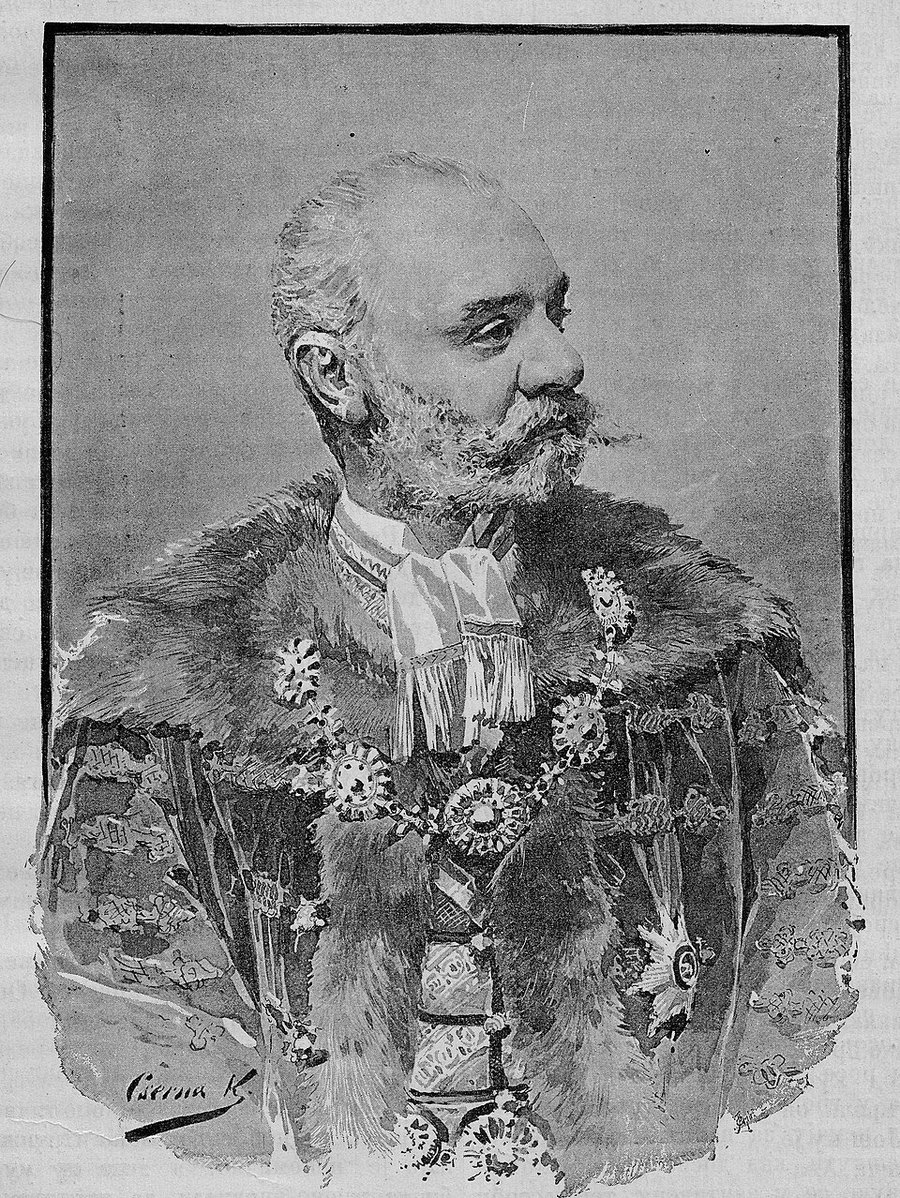
Fedor Nikolić de Rudna (1836–1903): lawyer, deputy, Civil Adlatus of Bosnia and Herzegovina and member of the House of Magnates — the family’s best-documented member.
Birth, family and studies
Fedor was born in Temesvár (today Timișoara) on 7 June 1836, the second son of Jovan (VII), owner of the Macedonia estate in Torontál County, and of Savka Obrenović, daughter of Prince Miloš of Serbia. His mother died in 1848, when he was twelve.
He went to the gymnasium at Temesvár and in Vienna and studied law at the University of Graz. After his studies he served for a short time as a clerk in the office of Count Coronini.
English Wikipedia says that he completed his studies at Graz in 1858. Neither Marcov nor Markov and Glăvan gives a year.
In 1854 his father was made an Austrian baron, and the title was extended to his sons Miloš, Fedor and Mihály. The sources give two different days for the grant: 18 November and 22 April.
The Diet, the bar and travel
In 1861 Fedor was elected to the Hungarian Diet for the district of Párdány (today Međa), on the programme of Deák’s party. From 1865 he sat for Zsombolya (Jimbolia), and in 1867 he gave up that mandate. Markov and Glăvan print 1860 for the first election; the archive takes 1861 from Marcov, the same author’s earlier article (S2).
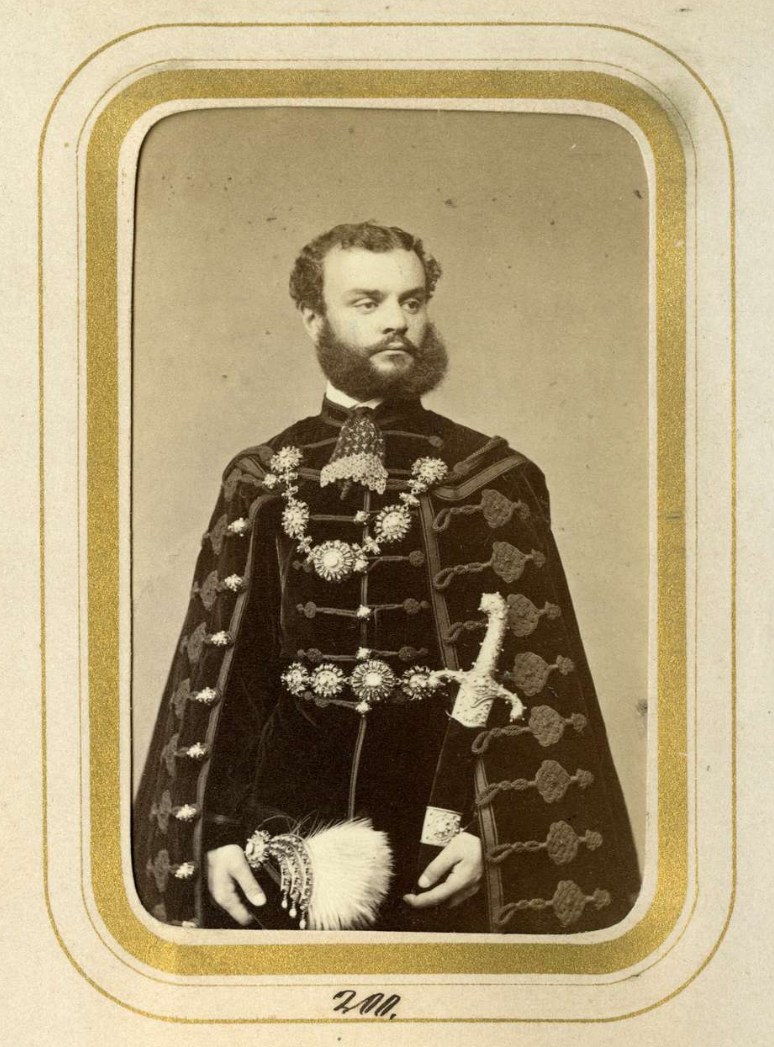
On 27 June 1862 he passed the bar examination, and he practised under the Temesvár lawyer von Sulnok.
In 1867–68 he travelled in western Europe to study the administration, the economies and the institutions of the countries he visited. He stayed longest in London and Brussels.
The inheritance from Prince Mihailo
On 10 June 1868 Prince Mihailo Obrenović, Fedor’s uncle, was assassinated in Belgrade. Fedor and his father, Baron Jovan, reached the city on 12 June 1868. The 2021 paper prints “10 May” for the assassination, a slip (S1).
Fedor, his brother Mihajlo and the barons Bajić, all children of the prince’s sisters, came to an agreement with the prince’s widow, Countess Júlia Hunyady, whom the 1903 obituary calls “Princess Arenberg” after her second marriage. The prince’s property in Romania was divided among the heirs only in 1873, after an agreement at Bucharest on 8 June. Fedor received the estates of Mavrodin and Buzescu in Teleorman County, Tămădea-Tămășești in Ilfov County and a quarter of Andrășești; the Estates page shows them on a map.
Marriage and children
Fedor married the opera singer Wilhelmina Hirsch, born at Lemberg on 27 June 1848, on 18 May — in 1869 at Vienna, says a genealogical table, but in 1879, says the 1903 obituary, which Marcov, Markov and Glăvan and English Wikipedia repeat. The identical day and month suggest a single event, and since the couple’s children were born from 1870 on, the archive shows 1869. The obituary praises her talent and beauty and calls her a woman of rich education.
They had five children, three of whom were alive when Fedor died in 1903: Johanna (Jeanne), Baroness Duka de Kádár, whose husband was a legation secretary and a member of the House of Magnates; Fedor II, then an attaché in the Foreign Ministry; and Elisabeth, Countess Hardegg, whose husband was a lieutenant-colonel of hussars. The other two, a son János and Micheline, had died in 1877 and in 1901. Micheline was born in Sarajevo, during her father’s years in Bosnia.
Serbian cultural life
In December 1878 Fedor was elected to the executive committee of the Serbian National Theatre in Novi Sad.
In 1880, the 1903 obituary says, Fedor returned to politics, and the Foreign Ministry gave him several important missions to the governments of the “Baltic countries”. Marcov, following Milankov, names a diplomatic mission to Romania as the reason why Matica srpska, the Serbian cultural society, honoured him that year with one of its most prestigious distinctions; he had become a member of the society on 18 September 1880. “Baltic” may be a slip for “Balkan”, but that is the archive’s guess, and no source says so.
English Wikipedia calls him a founder of the patriotic newspaper Srpski dnevnik (“Serbian Daily”) and later president of the Serbian Orthodox community in Budapest; Serbian Wikipedia calls him the owner of the newspaper, published at Pest. Neither Marcov nor Markov and Glăvan mentions the newspaper or the community.
Civil Adlatus in Bosnia, 1882–86
When Bosnia and Herzegovina had been pacified and the post of civil adlatus — the civil assistant of the provincial governor — had been created, the Common Finance Minister, Béni Kállay, chose Fedor for it, since he knew his abilities and his trustworthy character very well. The sources give 15 July 1882 for his official appointment (Markov and Glăvan) or for his naming as Privy Councillor with the style “Excellency” (Marcov). Fedor reached Sarajevo on 1 August 1882, when the situation was far from stable, only three years after the occupation, and he held the post until November 1886.
Besides the houses of Turkish type, Sarajevo then had only a few “European houses”. The former Austro-Hungarian consulate, a Turkish building, was adapted and became the “Nicolics house”, the meeting place of the city’s high society. Because Fedor was related to the Serbian royal house of Obrenović, native notables also came to the soirées held there, and Austro-Hungarian officers and officials made their first contacts with the local elite in a relaxed atmosphere.
In October 1882, during his term in Bosnia, King Milan I Obrenović conferred the Grand Cross of the Order of Takovo on Fedor at Belgrade. Marcov calls it the highest distinction of the Serbian kingdom, and says that the occasion reaffirmed the good relations of the Obrenović dynasty with Austria-Hungary. On 4 May 1884 Fedor received the Order of the Iron Crown, first class; Marcov ties it, like his rank of Privy Councillor, to the services he rendered in Bosnia.
Fedor left the post in November 1886, to the regret of the people of the province and of the whole country. Sarajevo and other Bosnian towns made him an honorary citizen, and at the end of his mission he received a letter from the Emperor expressing satisfaction and thanking him for his exceptional services in the province. Twenty years later, at the beginning of the twentieth century, his name was still mentioned with appreciation in Bosnia, and many legends told of his love of justice and impartiality.
As a man, in private life he was an extremely beloved person, a generous man with a big heart. He helped the poor everywhere, and for his charitable acts they will never forget him.
Parliament and the Church Congress
The sources do not agree on when Fedor became a Hungarian baron. Marcov dates the grant of the Hungarian baron’s title to 1875. Markov and Glăvan, citing Milankov, say that on 10 February 1886, while he was serving in Bosnia, the Hungarian king gave him the title; he already held an Austrian barony from 1854. The archive shows both dates.
In 1886 Fedor was appointed a member of the House of Magnates, the upper house of the Hungarian parliament, and he remained one until his death. In his last years he no longer stood for the House of Representatives and attended the Magnates only when important matters were discussed.
Fedor sat in the House of Representatives for Nagykikinda (Kikinda) until 1896. The sources date the start of his mandate to 1886 (Marcov), 1887 (English Wikipedia) or 1888 (Markov and Glăvan, “two years later” than 1886). Markov and Glăvan add that he stood on a liberal programme, won the unanimous support of the voters of Kikinda and represented the district over three mandates.
In 1892 and again in 1896 the parliamentary seat of Timișoara, his native city, fell vacant, and many of his admirers proposed him. Both times Fedor declined, thanking those who had proposed him; the second time he added that he no longer wished to be a deputy. He intervened with the government on the most important problems of the city of his day — the establishment of a higher-education institution, the regulation of the Bega canal — accompanied the city’s delegations and always stressed with pride that he had been born there.
In 1890 Fedor was appointed Royal Commissioner to the Serbian Orthodox Church-National Congress, and he held the post until 1901; Markov and Glăvan give 1902. The sources credit him with special merit in the development of Serbian autonomy and of harmony between church and state. At the start of his term, on 6 May 1890, he was present when the foundation stone was laid of the new gymnasium and theological seminary at Sremski Karlovci; his signature is among those on the letter placed in the foundations, with the list of the institution’s former directors.
Banks, companies and land
In the autumn of 1890, on the initiative of several Serbian aristocrats of Hungary, a credit bank was founded at Novi Sad. Its majority capital was held by Patriarch Georgije Branković, Fedor and the landowner Lazar Dunđerski. Most of the founders and shareholders were Serbs, but anyone could join, and the founders’ declared aim was to give entrepreneurs, merchants and farmers of southern Hungary quick, cheap credit.
At the end of the nineteenth century Fedor owned about 6,360 jutros (holds) of land, about 3,660 hectares by the archive’s conversion. That put him second, after Lazar Dunđerski, among the wealthy Serbs of Hungary. Rudna was the centre of his domain, and besides his own holdings he managed the large Romanian estates that he had inherited personally from Prince Mihailo; the Estates page explains the units.
| Body | Post | Since | Sources |
|---|---|---|---|
| Temeser Agrar-Sparkassa A.G., a savings bank | President | Its foundation, 1869 |
|
| The Lloyd society of Timișoara | President | Its foundation, 1878 |
|
| Ungarische Handels A.G., Budapest | President | not stated |
|
| Military Service Insurance Institute (Militär-Dienst-Versicherungsanstalt) | President | not stated |
|
| Kikinda Steam Mill, a joint-stock company | President | not stated |
|
| Match factory of Timișoara (Zündwaren), a joint-stock company | President | not stated |
|
| Vienna society for life insurance and pensions | Vice-president | not stated |
|
| Vienna insurance society | Vice-president | not stated |
|
| Tisza Valley Society | Vice-president | not stated |
|
| First Hungarian General Insurance Society | Member of the board | not stated |
|
| Hungarian Land Credit Society | Member of the supervisory commission | not stated |
|
| Timiș–Bega Water Regulation Society | Member of the executive committee | not stated |
|
| Temeswarer Gewerbebank | Protector for many years | not stated |
|
Collector and donor
His only hobby, the obituary says, was collecting watches and clocks. The collection, which held many unique pieces, was called the richest and most valuable of its kind.
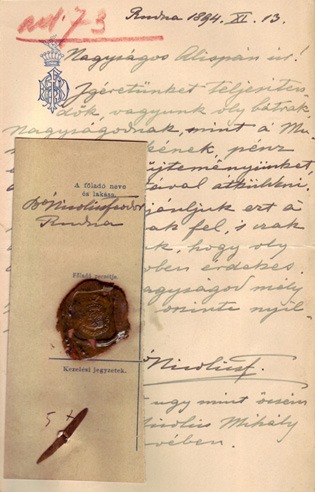
In a letter of 13 November 1894 Fedor and his brother Mihajlo gave a numismatic collection — 29 gold coins, 297 silver coins and about 190 bronze coins — to the historical and archaeological museum society of southern Hungary at Temesvár, the pre-war name of the Banat Museum, now the National Museum of Banat. The gift was recorded at the society’s monthly meeting on 22 December 1894.
Working habits
By eight in the morning Fedor was at his desk, dealing first with his correspondence; his punctuality and conscientiousness were known everywhere. The rest of the day and the night he spent on the institutions he led or in parliament, and on his own estates and the large ones in Romania, so that little time was left for sport and hobbies.
In his later years he devoted himself to favourite plans, among them a navigable canal between the Danube and the Tisza that was also to take in the Bega and the city of Timișoara.
Illness, death and funeral
At the beginning of 1902 Fedor, who had generally enjoyed good health, fell ill. Heart trouble, to which asthma was added, caused him ever greater difficulties, and he also suffered from rheumatic pains; he sought a cure at Vienna and then at Baden. For months he lay ill in his castle at Rudna, where none of his doctors, among them well-known professors — Professor Hawas of Budapest and Dr. Sternfeld of Timișoara — could do anything for him.
After a long struggle Fedor died on the evening of 27 February 1903, at 8:30, in his castle at Rudna, surrounded by his whole family. The forensic physician Dr. Heinrich Szigeti embalmed the body. In Timișoara, the city of his birth, the news caused great sadness: black flags were flown on the public buildings, and the institutions and companies of which he was president and founder published notices of condolence. At Rudna, the centre of his domain, there was the same mourning, with a black flag on every house and the front of the castle wrapped in black.
On the morning of 3 March the staff of the funeral company “Szent Margit”, under its director Sebes, carried the metal coffin to the Serbian Orthodox church at Rudna, where the catafalque had been raised. The whole interior of the church was covered in black cloth, and the houses between the castle and the railway station were decorated in mourning.
The funeral took place on Tuesday, 4 March 1903, at eleven in the morning, “with great pomp”. Bishop Lukijan Bogdanović of Buda, who was also administrator of the Serbian Orthodox eparchy of Timișoara, officiated, assisted by Archimandrite Georgije Letić, the protopresbyters Jovan Kovačević and Đura Stajić, and twelve more priests. About 4,000 people came, among them the people of Rudna and of the neighbouring villages. The family put on free special trains, from Timișoara (leaving at 7:30 in the morning, returning at 4:30 in the afternoon) and from Modoš (leaving at 9:30). The metal coffin was placed in the family chapel on the Rudna estate; Markov and Glăvan call it a family crypt, and the Estates page says where the tomb is said to stand today.
The will was opened at the funeral. His son Fedor II was the universal heir; his daughters received the share of the property that corresponded to their appanage, and his widow received the right to use a considerable part of the estate.
The news was telegraphed to the Cabinet Chancellery, to the court at Belgrade and King Alexander Obrenović, to the office of the Hungarian prime minister, to all the ministers, to the House of Magnates, to Parliament and to the National Casino, to the government of Bosnia, to the foreign minister, Count Goluchowski, and to all the court officials.
Telegrams of condolence came from the mayor of Timișoara, Dr. Carol Telbisz; from the Lloyd society, of which Fedor had been president since 1878 and whose twenty-fifth anniversary was near; from the Agrar-Sparkasse, of which he had been president since its foundation in 1869; and from the Gewerbebank, of which he had long been the protector. Condolences were also received from:
- King Alexander Obrenović of Serbia and King Carol of Romania
- Archduke Franz Ferdinand, the heir to the throne, and Archduke Ludwig Viktor
- The Hungarian prime minister, Széll, and all the members of the Hungarian government
- Patriarch Georgije Branković
- Baron Bánffy
- Count Ludwig Apponyi, the Hungarian court marshal
- Albert Apponyi, president of the House of Representatives
- Archduke Josef
- Dessewffy, the Catholic bishop of Cenad
- Prince Lobkowitz
- The commanders of the army corps at Budapest and at Sarajevo
Titles and honours
| Title or honour | Date | What the sources say | Sources |
|---|---|---|---|
| Austrian barony | 1854 | Conferred on his father, Jovan (VII), and extended to his sons Miloš, Fedor and Mihály. The day is given as 18 November or 22 April. |
|
| Hungarian barony | 1875 or 10 February 1886 | Marcov dates the grant of the Hungarian baron’s title to 1875. Markov and Glăvan, citing Milankov, date it to 10 February 1886, while Fedor was serving in Bosnia. The sources do not reconcile the two. | Sources differ C8 |
| Distinction of Matica srpska | 1880 | One of the society’s most prestigious distinctions, for a diplomatic mission carried out in Romania. He had become a member of the society on 18 September 1880. |
|
| Privy Councillor, with the style “Excellency” | 15 July 1882 | Marcov dates his naming as Privy Councillor, “for services so important”, to this day. Markov and Glăvan give the same day for his official appointment as Civil Adlatus. | Sources differ C11 |
| Grand Cross of the Order of Takovo | October 1882 | Conferred at Belgrade by King Milan I Obrenović; Marcov calls it the highest distinction of the Serbian kingdom. |
|
| Order of the Iron Crown, first class | 4 May 1884 | Marcov ties it, like the rank of Privy Councillor, to the services Fedor rendered in Bosnia. | |
| Honorary citizen of Sarajevo and of other Bosnian towns | 1886 | Marcov names the honour but gives no date; English Wikipedia dates it to 1886, when Fedor left Bosnia. | |
| Letter of thanks from the Emperor | 1886 | On the end of his mission in Bosnia and Herzegovina, which he left in November 1886: the Emperor expressed his satisfaction and thanked him for his exceptional services in the province. |
|
| Grand Officer of the Order of the Star of Romania | Date not given | Reported by English Wikipedia alone. Neither Marcov nor Markov and Glăvan lists it among his orders. | Reported only |
| The title of főispán (lord-lieutenant) | Date not given | Reported by English Wikipedia alone. Főispán is the Hungarian word for the head of a county. | Reported only |